| News Details |
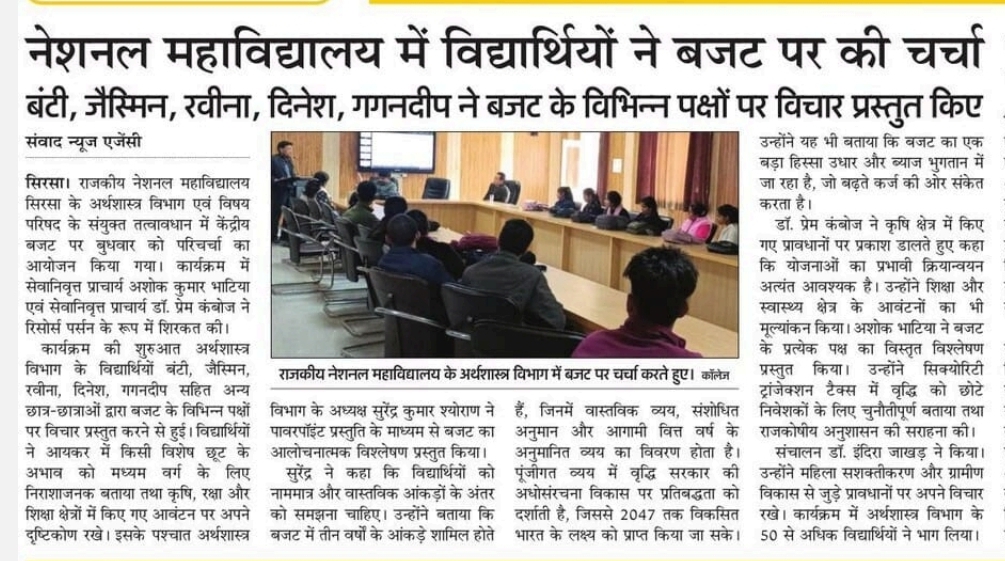
Discussion on the budget at Government National College, Sirsa.04-02-26
Posted on 05/02/2026
Discussion on the Budget at Government National College, Sirsa: Today, the Economics Department and Subject Council of Government National College, Sirsa, organized a program for a discussion on the budget. Retired Principal Mr. Ashok Kumar Bhatia and retired Principal Dr. Prem Kamboj participated as resource persons in this program. First, students from the Economics Department, including Bunty, Jasmine, Raveena, Dinesh, Gagandeep, and others, presented their views. Highlighting various aspects of the budget, the students said that the government has disappointed the middle class by not providing any significant tax relief. They also presented their views on the allocations made to the agriculture, defense, and education sectors. Following this, Mr. Surender Kumar Sheoran, Head of the Economics Department, presented a critical analysis of various aspects of the budget through a PowerPoint presentation. He emphasized that economics students should understand the difference between nominal and real values. He explained that the budget contains details for three years: the current budget includes details of the actual expenditure for the financial year 2024-25, the budget estimates and revised estimates for 2025-26, and the estimated expenditure for the upcoming financial year 2026-27. Mentioning the key points of the budget, he said that the increase in capital expenditure indicates that the government is focusing on infrastructure development to achieve the goal of a developed India by 2047. He added that in the current budget, the government appears to be striving to develop the manufacturing sector and is making efforts to increase employment opportunities. Speaking on the sources and uses of funds, he explained that 24 paise of every rupee comes from borrowing, which points to a fiscal deficit problem. He also mentioned that 26 paise is going towards interest payments, highlighting the growing debt burden. Following this, Dr. Prem Kamboj discussed the provisions made in the budget for the agricultural sector. He said that while provisions have been made in the budget for the development of the agricultural sector, the proper implementation of government schemes is crucial. He also presented a critical evaluation of the allocations made in this budget for the education and health sectors. Following this, Mr. Ashok Kumar Bhatia, while explaining each aspect of the budget in detail, stated that the increase in the Securities Transaction Tax from 0.02 to 0.05 shows that the government wants to keep small and medium-sized investors out of the stock market. Speaking on the difference between the budget estimates and the revised budget estimates, he said that this difference reflects the shortcomings in the implementation of government schemes at the ground level. He urged the students to understand their own household budgets so that they can better understand the national budget. He explained that the government has demonstrated fiscal discipline by controlling the fiscal deficit. He informed the students that the recommendations of the 16th Finance Commission have been implemented in this budget, which will form the basis for determining center-state financial relations for the next five years. Dr. Indira Jakhar moderated the event and, while doing so, shared her views on various dimensions of the budget. She presented a critical analysis of the allocations made for women's empowerment and rural development. More than 50 students from the Economics Department participated in the program. At the end of the program, Mr. Surendra Kumar Shoran, Head of the Economics Department, thanked everyone and said that such programs help in developing critical thinking skills among students. He said that this program would greatly benefit the students and that similar programs would continue to be organized in the future.
|